Planning for retirement is a major business milestone. Take these steps today to help ease the transition into your next chapter:
- Define your vision: Set a clear savings goal by mapping out your retirement timeline and ideal lifestyle.
- Choose the right plan: Pick the best retirement account for your business to help unlock potential tax advantages.
- Protect your hard work: Spread your investments outside your company and create a clear business exit strategy.
- Partner early with experts: Form a trusted team with a wealth advisor, CPA and attorney to handle your transition.
It can be tempting to put off retirement planning because your small business takes up the bulk of your time and responsibilities. But, retirement planning is critical when you want to step away from your company. While a small percentage of small business owners anticipate retiring early in life, the vast majority plan to transition in their late 50s to mid-60s or beyond. Whether your target retirement date is five years away or 20, you can benefit by starting the planning process now.
When it’s time to enter the next phase of your life, you must have a plan that will help you live comfortably. Think about retirement in four phases: accumulation, transition, distribution and legacy. The accumulation phase begins when you’re still building the company. From there, you transition out of daily operations. distribute your assets and create the legacy you’ll leave for the next generation.
In this article, we’ll discuss the importance of retirement planning for small business owners and strategies to help you gain future financial independence.
1. Define Your Retirement Goals
Retirement planning doesn’t happen overnight. You need time to put together your retirement goals and accumulate assets early for a solid financial cushion. If you are curious on how to retire from your business while protecting your financial future, consider details like where you want to live, how much that will cost, what expenses you’ll have and where you’ll get your retirement income.
Start by answering the following questions:
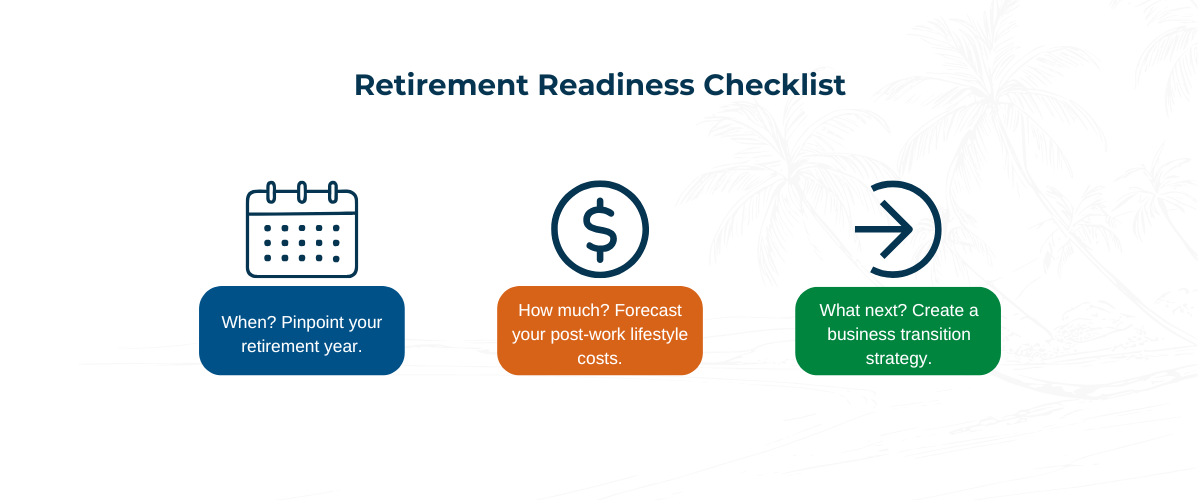
- When do you want to retire? Calculate how much time you have left at your business and how much money you need to save before you retire.
- What kind of retirement do you want? If you intend to move or travel, you’ll need enough money in your retirement plan to support your lifestyle.
- How much money do you need to set aside? Once you know when you want to retire and the kind of lifestyle you want, forecast how much money you’ll need. You may be able to adjust your retirement plan contribution levels annually based on your company profits and investment strategies as you get closer to retirement. A wealth advisor can help you define these goals and keep you on track.
Make sure your goals are written down, specific, measurable and time-sensitive, so you know how and when to achieve them.
2. Choose the Right Retirement Savings Plan
After you’ve outlined your goals, determine your retirement plan. The right retirement plan will not only strengthen your overall strategy but can also open the door to tax advantages. Choose the option that best suits the needs of you and your business and how much financial independence you want to achieve in retirement.
Below are some of the most common retirement plans:
Traditional or Roth Individual Retirement Account (IRA)
Traditional and Roth IRAs are the most basic options. A traditional IRA allows you to make tax-deductible contributions. Taxes are deferred until savings are withdrawn. In a Roth IRA, taxes are paid upfront. The benefit is that withdrawals can be made tax-free in retirement. Not everyone is eligible to contribute to a Roth IRA based on their income, and the contribution limits are relatively low for these accounts.
Simplified Employee Pension (SEP) IRA
A SEP IRA is a type of tax-advantaged account used most often by those who are self-employed. This type of plan can be set up by either an employer or self-employed individual and allows the employer to make contributions to their employees’ accounts. It offers higher contribution limits and flexible funding options but requires employer contributions be made equally to all employees.
Savings Incentive Match Plan for Employees (SIMPLE) IRA Plan
A SIMPLE IRA is another tax-advantaged account and is designed for businesses with 100 or fewer employees. Employees can elect to contribute a percentage of their salary to a SIMPLE IRA account. You, as the employer, can then match up to a percentage of their salary; however, your company must match the same percentage for each employee who contributes. This plan has fewer administrative costs than a 401(k) plan but also has lower contribution limits and less flexibility.
Solo or Individual 401(k)
A solo 401(k) can cover you as a business owner and your spouse if they are employed by the business, but this may not be an option for you if you have additional employees beyond you and your spouse. For those eligible, it has higher contribution limits than an IRA or a SIMPLE IRA plan and fewer administrative costs than a traditional 401(k) plan.
Traditional 401(k) Plan
One of the more popular options is the traditional 401(k) plan. This plan is funded with employee contributions and matching contributions from you as the employer. There is a lot of flexibility in how you design a plan for your business, and there are relatively high contribution limits for owners and their employees. The popularity of this plan also makes it a desirable benefit to help attract and retain talented employees. The administrative costs are higher for this type of plan than they are for many others, making it cost-prohibitive for some smaller employers.
3. Diversify Your Retirement Savings
Having both tax-deferred (traditional) and tax-free (Roth) savings may help with your current taxes and long-term planning goals. Look at your cash flow, tax situation and long-term retirement goals to determine the optimal savings plan for you.
However, more important than diversifying the types of accounts you use, is diversifying your investment selections within these accounts. Avoiding a concentration of individual companies or even industries is important to managing your investment risk and increasing your odds of success. Mutual Funds and Exchange Traded Funds (ETFs) are a great way to achieve this diversification. But make sure to use funds with low expenses and a clear investment strategy. If you have a financial advisor to help you with these investments, make sure they are a fiduciary (an advisor who is required to act in your best interest). Unfortunately, not all financial advisors serve their clients in this capacity, so be sure to ask.
4. Develop an Exit Strategy
Once you’ve established your goals and implemented a personal retirement savings plan, create an exit strategy. Eventually you’ll leave your business or transition day-to-day operations to someone else. Although you might need years of planning to shape the future of your business, don’t leave it open to interpretation before you retire. It’s your legacy. You can sell it to a family member, an employee or a third party. Whatever you decide, create a succession plan before you move on. The plan should include your:
- Succession time frame and exit strategy.
- Named successor(s).
- Business valuation and marketability.
- Tax implications and finances.
.png?sfvrsn=a1d95f73_1 "Retirement Readiness Checklist")
5. Meet With Your Financial Advisors
Creating a retirement plan for a business owner can take a team of professionals. First, it’s recommended to visit with your wealth advisor at least five years prior to retiring. They will help guide you through the retirement planning process and tax planning strategies as well as offer general information about the different options available to you.
You’ll also want to talk with your CPA and business attorney. A CPA can offer tax advice regarding your succession and estate plans. A business attorney will make sure your business entity is structured properly, draft any necessary agreements, and also help ensure that your estate planning documents are in order. Together, these professionals can facilitate a tax-efficient transition for you and your family as you prepare for the next chapter in your journey.
People and circumstances change over time. The financial plan you’ve implemented may change over time, too. Review your plan periodically and adjust it based on your succession strategies or financial needs.
Reach out to our Wealth Management Team to learn about the retirement plan options that are best for your business.