Open communication with your ag lender gives your farm a major financial advantage.
- Stay Transparent: Share current numbers so your lender can advocate for you.
- Stress-Test Big Moves: Model best- and worst-case scenarios early to protect your cash flow.
- Align on Goals: Check your debt load together before taking on new land or equipment.
A farmer’s relationship with their agricultural lender is one of the most important business partnerships. When you build a healthy bond with your banker, you create a solid foundation for long-term financial success.
Like any good partnership, ag lending relies on trust, transparency and clear expectations. Here are a few key tips for having a strong relationship with your ag lender.
Share updated balance sheets to maintain open lines of communication.
Communication is everything. Your lender shouldn't just be someone you talk to once a year — they should be the first person you bounce ideas off of when exploring new opportunities or managing cash flow.
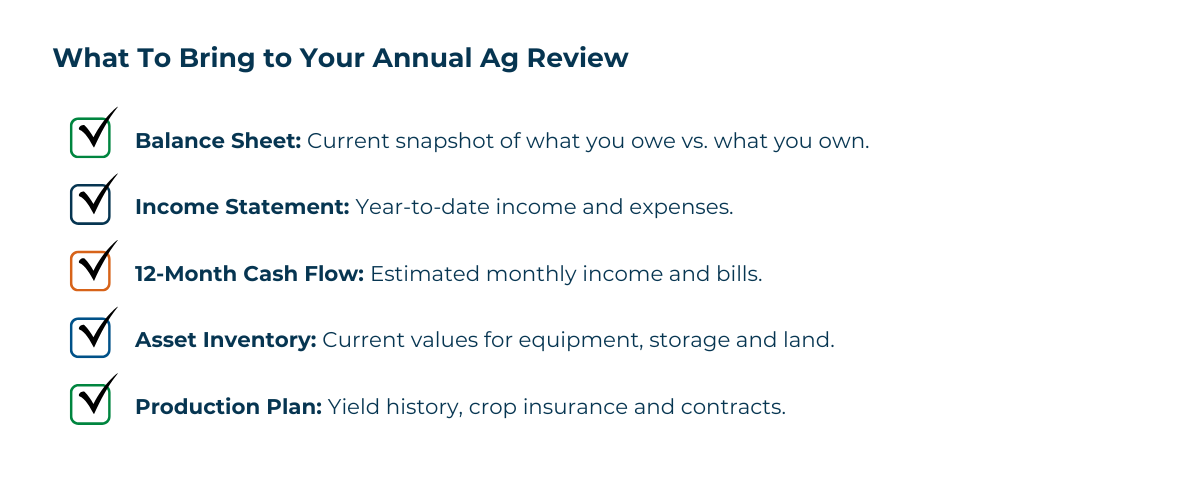
Instead of waiting for an annual review, stay in touch throughout the season. Share updated balance sheets and income statements as things change. Keeping your banker in the loop makes it much easier to quickly set up or expand a farm operating line of credit. This helps give you access to funds for seed, fuel, fertilizer and daily expenses.
Staying in regular contact also lays the groundwork for bigger, long-term conversations. For instance, when it’s time to pass down the farm, bringing your lender into succession planning early helps you ensure a smooth transfer of money and sets the next generation up for success.
Bring cash flow projections to help your lender advocate for you.
Your ag lender should be a good listener: someone who takes the time to know your story and your business goals and helps you achieve them. When choosing a lender, look for someone who understands the agriculture industry and the economic trends that could impact your business outcomes. When you allow your ag lender to serve as your advocate, they can connect you to other tools and resources, like the USDA Farm Service Agency (FSA).
Their agribusiness loan bridges the gap between what a farmer needs and what a lender is comfortable providing. An FSA loan benefits both parties. The farmer gets access to financing that might not otherwise be available while the lender faces less risk.

Explore "what if" scenarios to stay proactive against market shifts.
Your ag lender is positioned to help you through the good and bad times. But they can only do that if you keep them informed of any unexpected circumstances (personal or business) as they come up. You can avoid being surprised when a financial problem or emergency arises by taking a proactive approach. Before spring planting, sit down with your lender to run the numbers on these scenarios: a jump in fertilizer costs, a drop in grain prices or a rate hike on your variable loans. Running these scenarios through your cash flow projections will show you how much cash you need. For instance, if you’re likely to need more cash before fall harvest, your banker can work with you to potentially increase your operating line of credit.
Review debt-to-asset ratios to plan your long-term goals.
Goal setting is a major component of business development and growth. Goals give you focus, direction and motivation. In short, they help guide you on a focused path to your desired outcome. When you share your goals with your ag lender, they can help position you and your business to achieve them. For example, if you’re interested in purchasing additional land, they can explore this opportunity with you. First, they will look at your debt-to-asset ratio. This shows how much you owe versus how much of your farm you actually own. From there, your lender will check your cash flow to make sure you can handle the new payments. And if you move forward with the purchase, they can help you through the land loan process. Knowing your numbers upfront lets you bid with confidence and secures a smooth land purchase process when the right opportunity comes along.
Walk through your asset inventory list with your lender.
Numbers on a page only tell part of your story. Invite your lender for a farm visit and walk them through an updated asset inventory that lists your equipment, storage and land. Seeing your operation in person helps your banker understand your business.
Track your working capital to handle unexpected expenses.
Reviewing your working capital, such as the cash, stored grain and prepaid inputs you have on hand, with your banker helps you prepare for surprises. Maintaining a healthy balance protects your farm against sudden repair bills or falling crop prices. Together, you and your lender can figure out the right working capital target per acre to keep your farm growing.
No matter your farm’s size, an ag lender is a valuable partner for your agribusiness. They serve as your advocate and trusted advisor and connect you with financial tools and resources.
To learn more about how Northwest Bank can help support your farm, contact our Ag Bankers today.